Sevenoaks Interior Design: Inside A Contemporary Home Shaped by Objects and Everyday Living
Set within Sevenoaks, this home offers a considered example of Sevenoaks interior design – one that reveals itself gradually rather than all at once. At first, the architecture speaks most…
House of Willow Alexander·
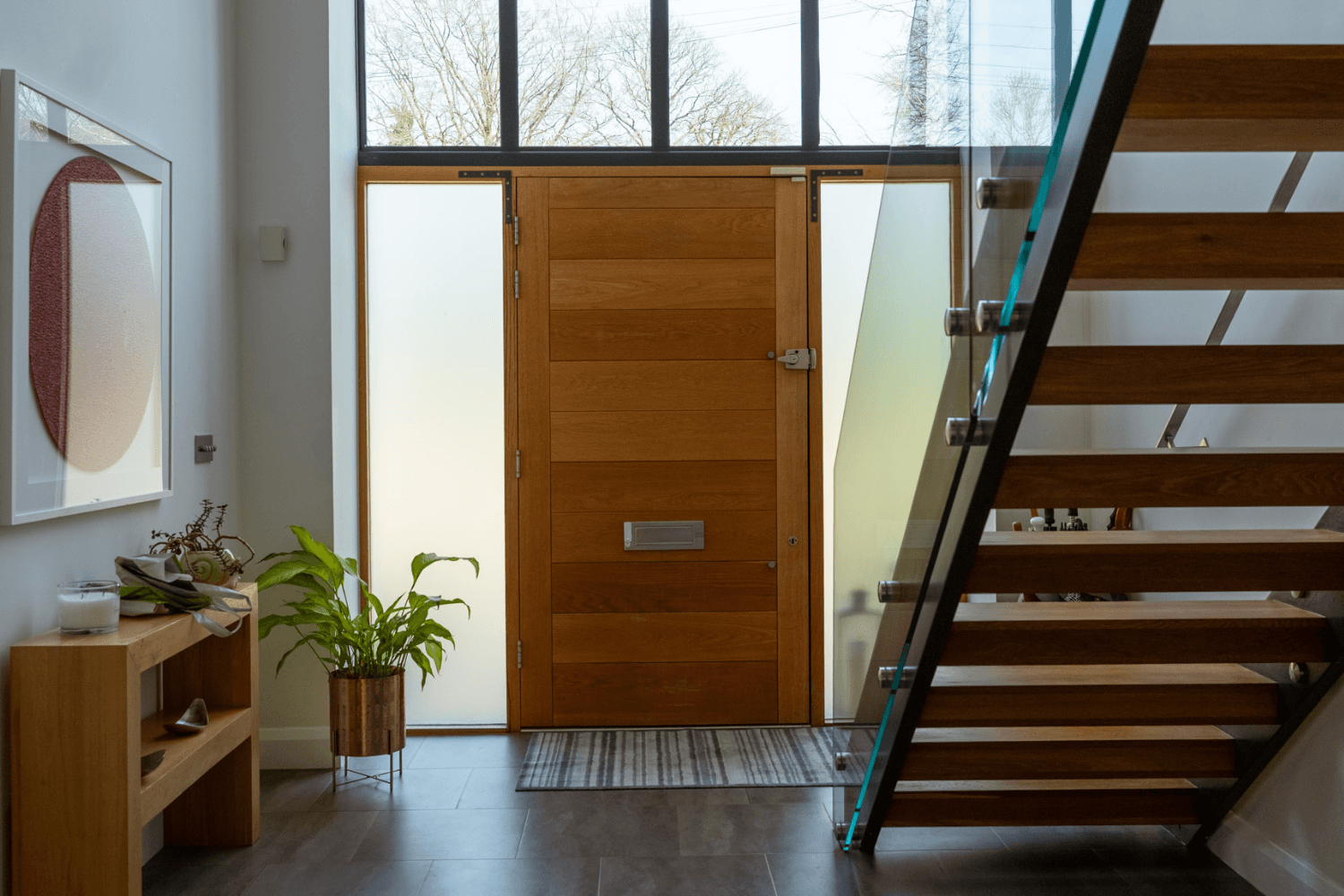
Set within Sevenoaks, this home offers a considered example of Sevenoaks interior design – one that reveals itself gradually rather than all at once.
At first, the architecture speaks most clearly. There is a sense of order – of space defined through proportion, material and light. Timber, glass and clean lines establish a calm, contemporary foundation, one that feels resolved without feeling rigid.
But this is only the beginning.
Because beyond that initial clarity, the home begins to shift. Objects emerge. Artwork interrupts. Personal details soften the structure. What appears, at first glance, to be a composed interior becomes something more layered – a space shaped not only by design decisions, but by the accumulation of things chosen, lived with, and allowed to remain.
Structure and Interruption
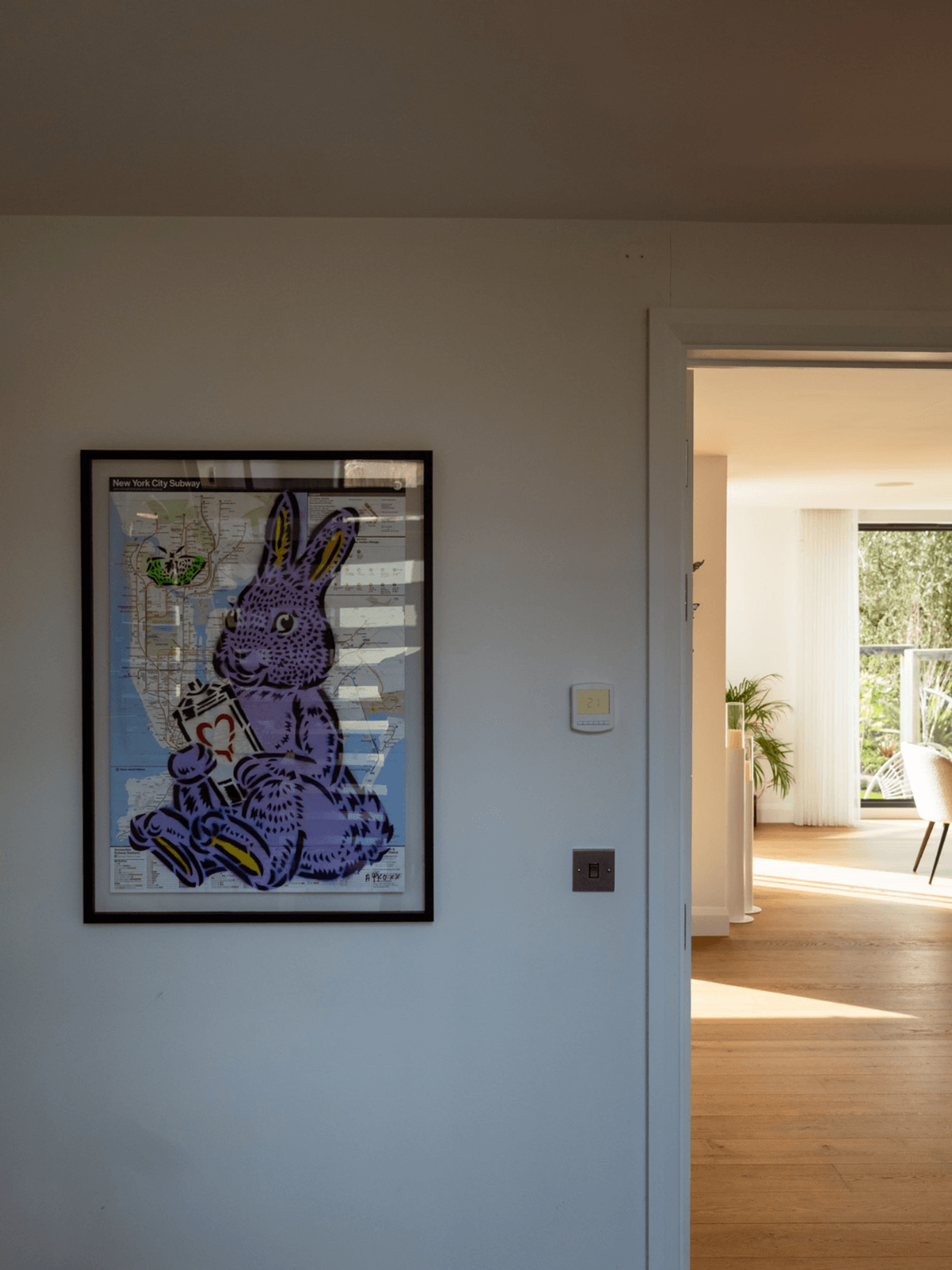
A playful intervention by Lady Aiko overlays the structure of the city with something more instinctive – bold, graphic, and deliberately disruptive.
Within this clarity, artwork becomes the first point of departure – a recurring idea in contemporary Sevenoaks interior design, where restraint allows objects to define atmosphere.
A framed work by Lady Aiko introduces a deliberate shift in tone. Spray-painted onto a New York subway map, the piece overlays a bold, graphic rabbit onto the ordered complexity of the city beneath it. There is a tension here between structure and spontaneity – the rigid system of the map disrupted by hand-applied gesture.
Aiko’s practice, shaped through her early work with Takashi Murakami and her roots in New York’s street art scene, sits between pop art and urban expression. The use of an existing visual system – in this case, the subway map – reflects a longer artistic lineage of appropriation, where familiar frameworks are reworked into something more personal, more immediate.
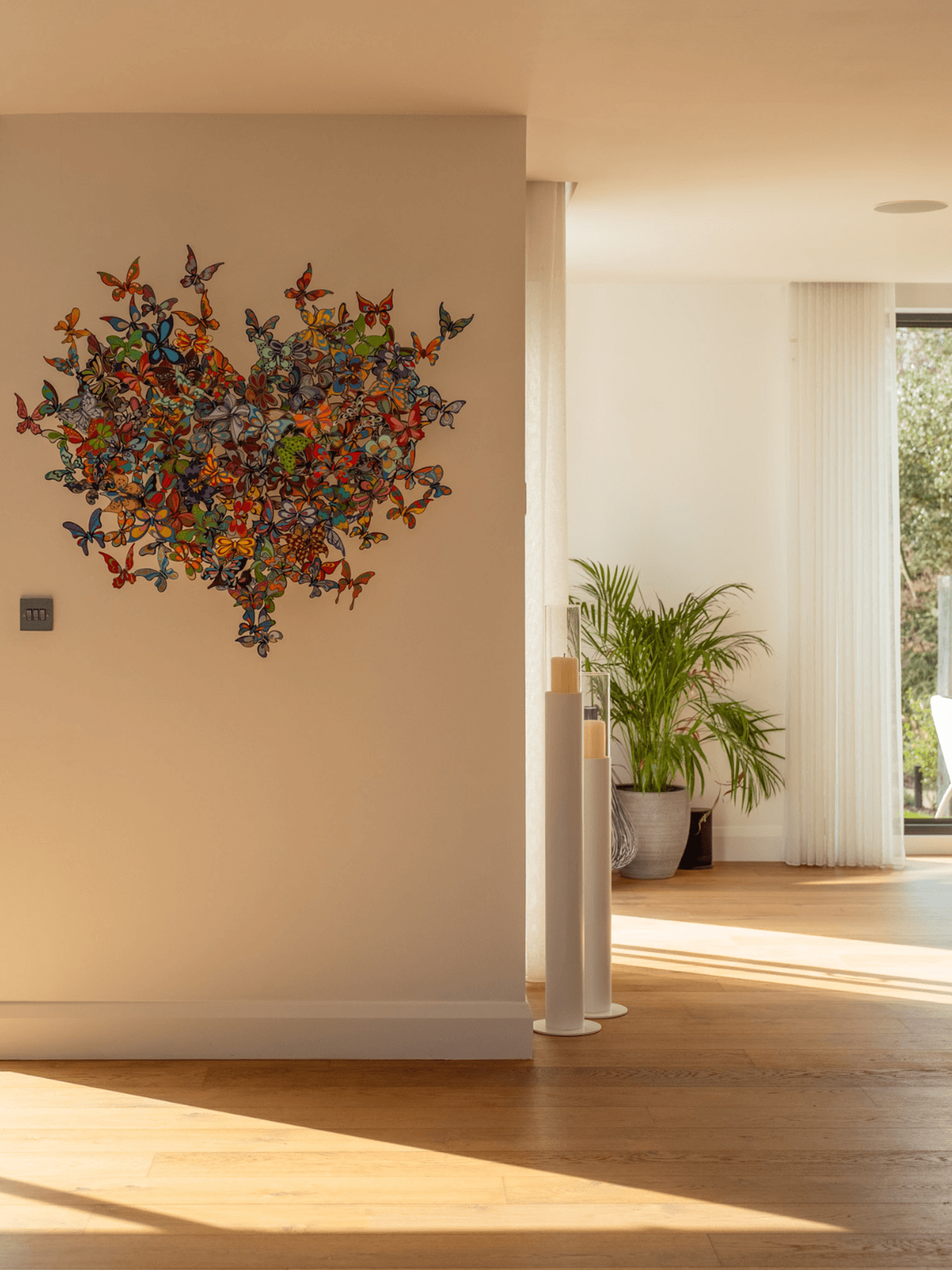
David Kracov’s My Heart Is All a Flutter introduces movement through repetition – hundreds of individual butterflies forming a single, shifting composition.
Elsewhere, a wall-mounted sculpture by David Kracov, My Heart Is All a Flutter, expands this dialogue. Composed of hundreds of individually formed butterflies, the piece builds a larger whole through repetition and variation – each element distinct, yet contributing to a unified form. Fabricated in painted metal, it moves beyond image into object, occupying space with a lightness that belies its complexity.
Kracov’s work often explores ideas of transformation and collectivity, using the butterfly as both symbol and structure. Here, it introduces a different kind of movement – less graphic, more organic – softening the geometry of the architecture without dissolving it.
These interventions do not compete with the architecture. They interrupt it – subtly, but with intent – creating moments where the space shifts from considered to expressive.
Vertical Space and Light
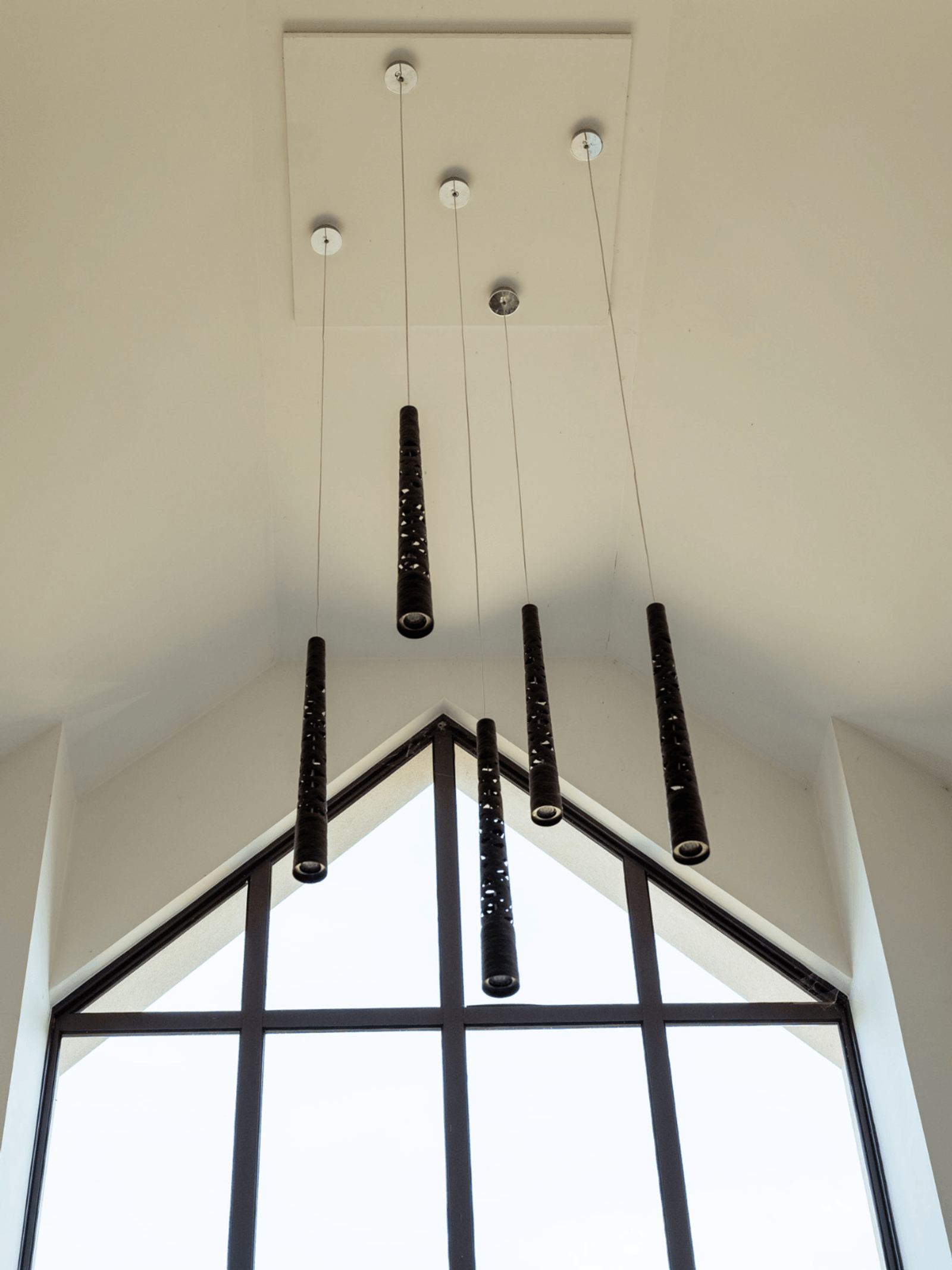
Suspended pendant lights draw the eye upward, emphasising height and introducing a quiet rhythm to the architectural space.
In the double-height stairwell, lighting takes on a more architectural role.
A series of suspended cylindrical pendants descend at varying heights, their elongated forms echoing the verticality of the space. The perforated detailing suggests a hand-worked or artisan process – possibly metal or ceramic – allowing light to escape in a controlled, patterned diffusion.
This approach reflects a broader shift in modern British and Sevenoaks interior design, where lighting moves beyond function into composition. Rather than a single point of illumination, light is distributed – fragmented – creating rhythm within the volume.
It is a gesture that feels both contemporary and rooted in earlier traditions of filtered light.
Furniture as Composition
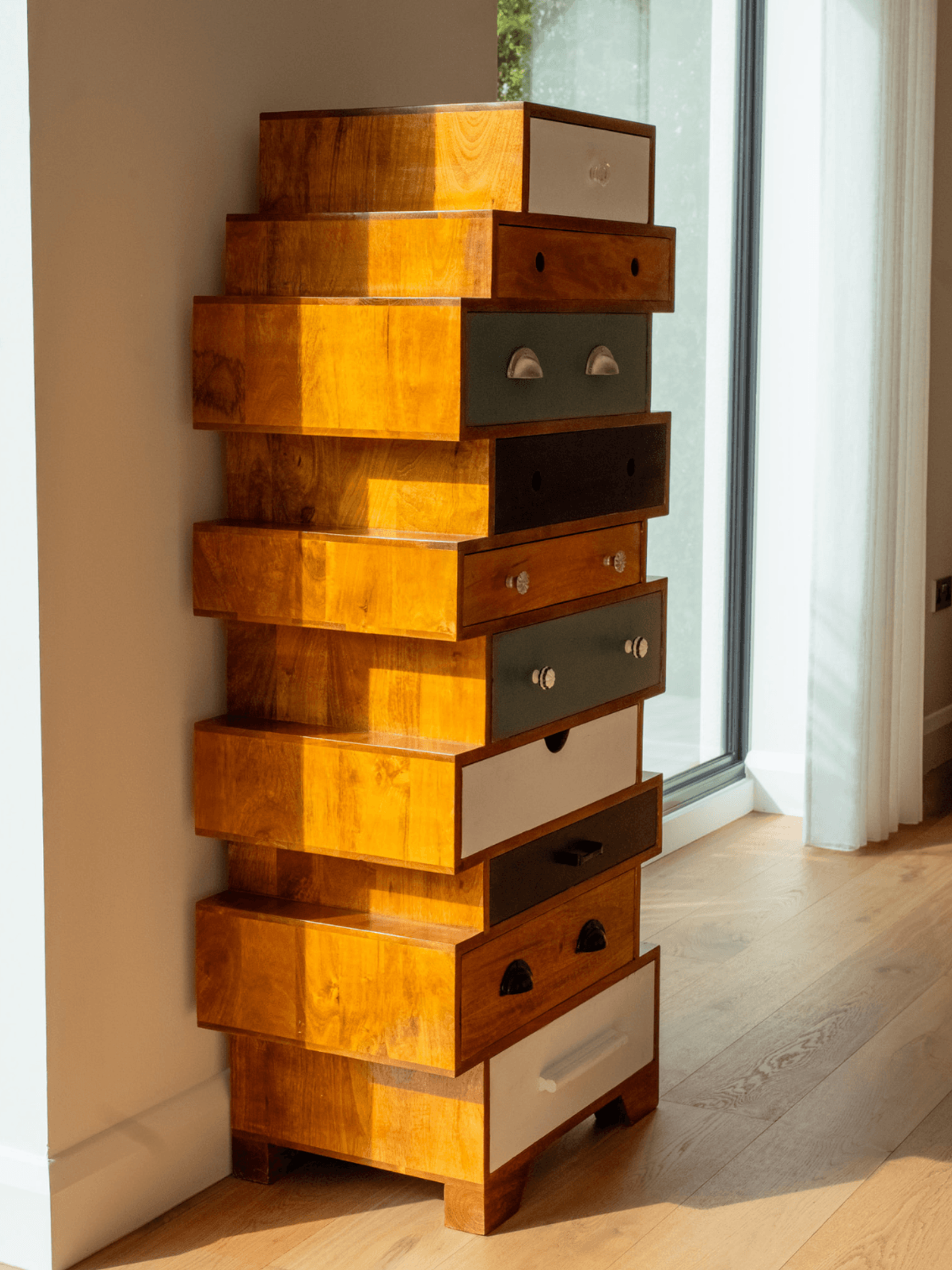
A sculptural chest of drawers introduces rhythm through variation – each section distinct, yet unified as a single, carefully composed piece.
If the architecture establishes order, the furniture begins to introduce variation.
The tall chest of drawers – constructed from a stack of offset timber volumes – stands as one of the most distinctive pieces within the home. Its irregular composition recalls the experimental furniture of the late twentieth century, particularly the studio furniture movement, where makers such as Paul Evans challenged conventional forms through fragmentation and asymmetry.
Each drawer differs slightly – in tone, handle, or proportion – creating a structure that feels accumulated rather than designed in a single gesture.
Placed near glazing, the piece is activated by light. The timber shifts in tone throughout the day, its surface revealing grain and variation that would be lost in a more controlled setting.
This is furniture that operates as object as much as utility.
The Dining Room: Balance and Restraint
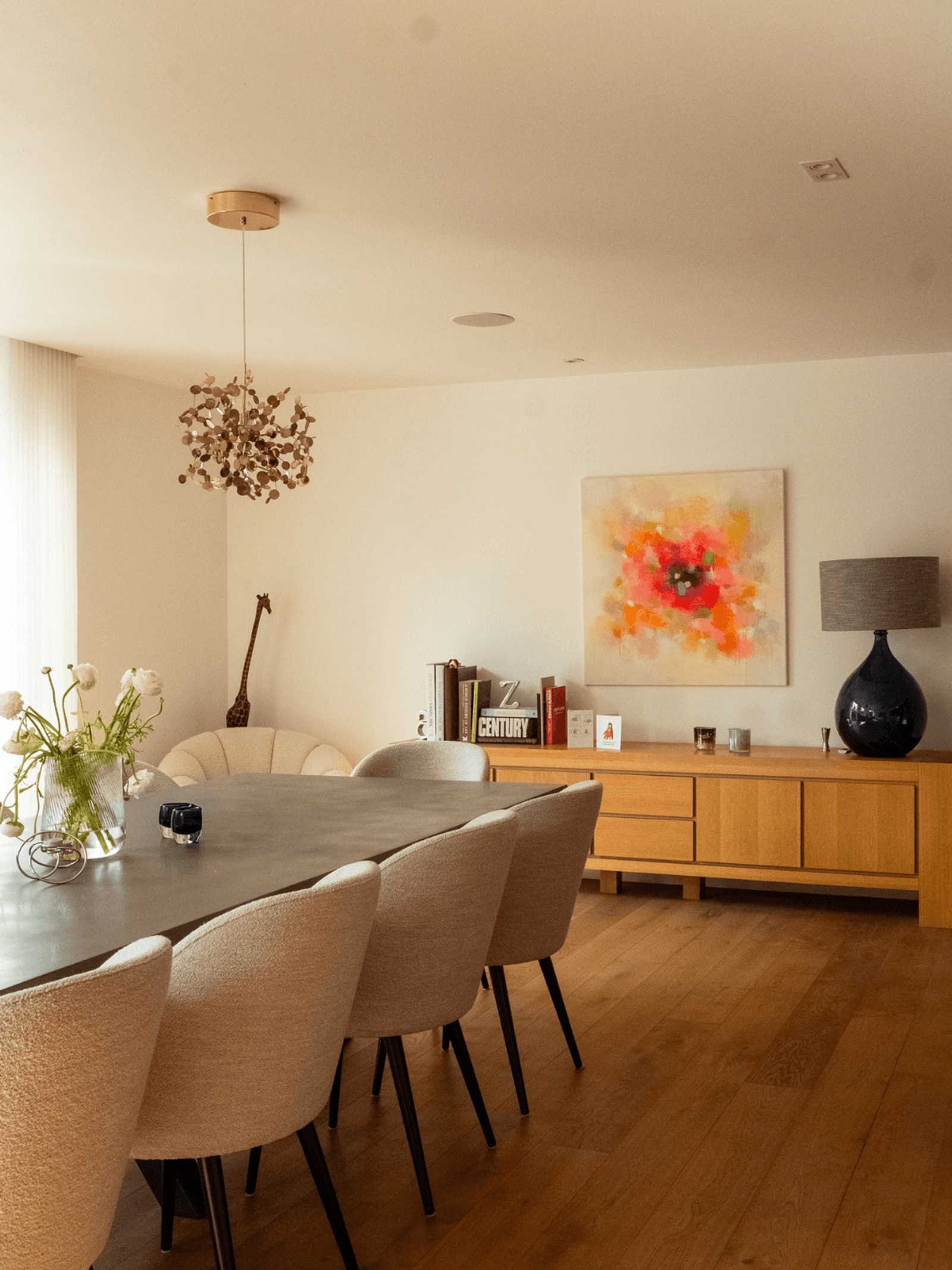
A warm, considered dining space where natural materials and soft tones are punctuated by a vibrant abstract artwork.
In the dining area, the composition settles.
A large table anchors the room, surrounded by upholstered chairs whose soft texture contrasts with the solidity of the surface. The arrangement draws from mid-century dining principles, where proportion and spacing were prioritised over ornament.
Above, a branching pendant introduces a lighter structure. Its form suggests a contemporary reinterpretation of mid-century molecular lighting – a design language influenced by atomic-age aesthetics, now softened into more organic expressions.
Behind, a long timber sideboard provides continuity. On it, objects sit without strict alignment — books, a ceramic lamp, and a vibrant abstract painting layered in colour.
The painting introduces a different energy. Its palette suggests contemporary gestural abstraction, where colour is layered rather than defined – a quiet contrast to the structured architecture around it.
Smaller Objects, Quieter Roles
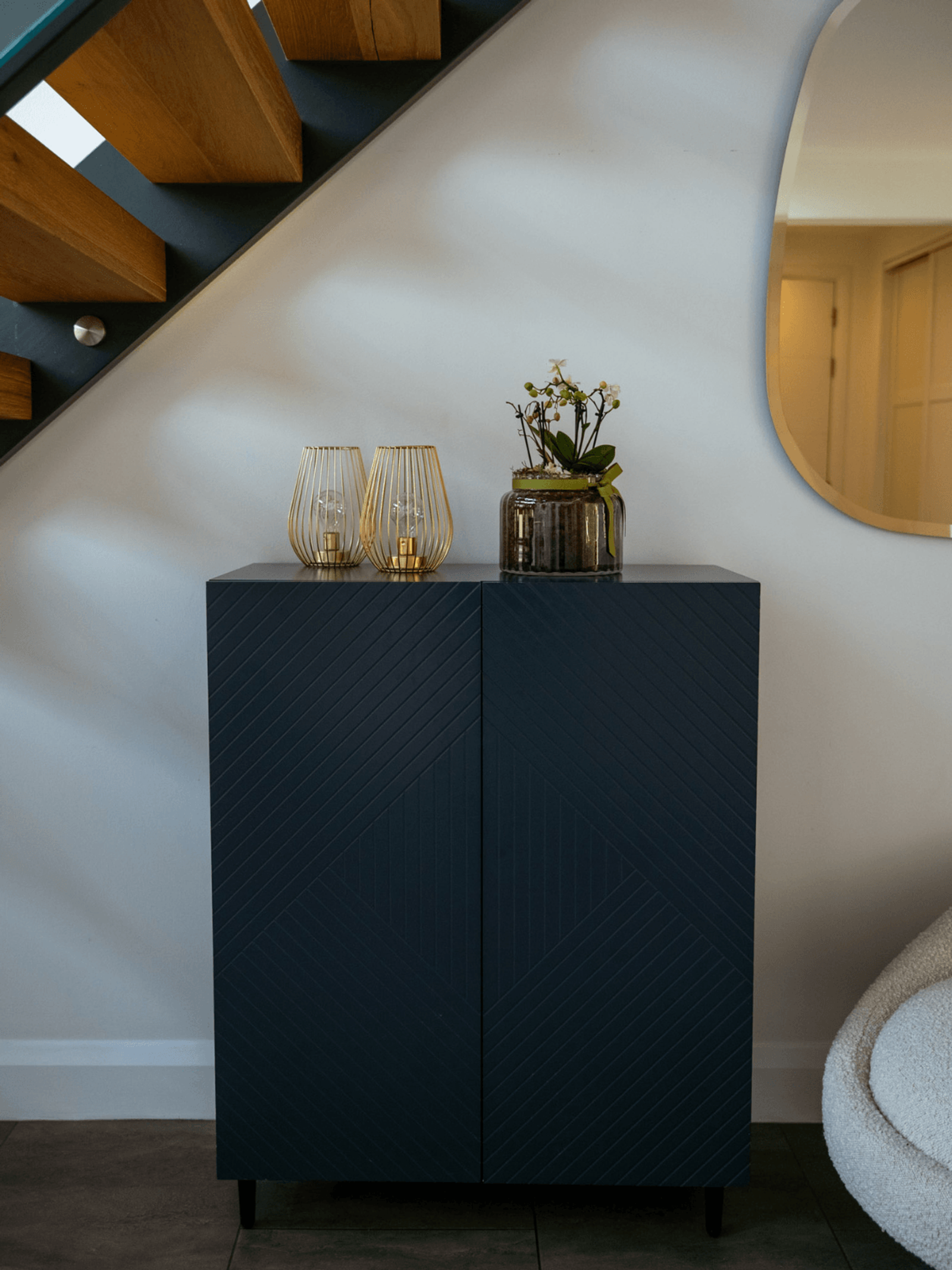
A quiet moment of composition beneath the staircase, where lighting, texture and planting are carefully balanced.
It is in the transitional spaces that the home reveals its rhythm.
A deep blue cabinet sits beneath the stair, its surface detailed with subtle linear patterning. The colour provides a visual anchor against the lighter walls. On top, two gold-toned wire lamps introduce a finer geometry, their open structure exposing the bulb – part of a long-standing dialogue in lighting design between visibility and concealment.
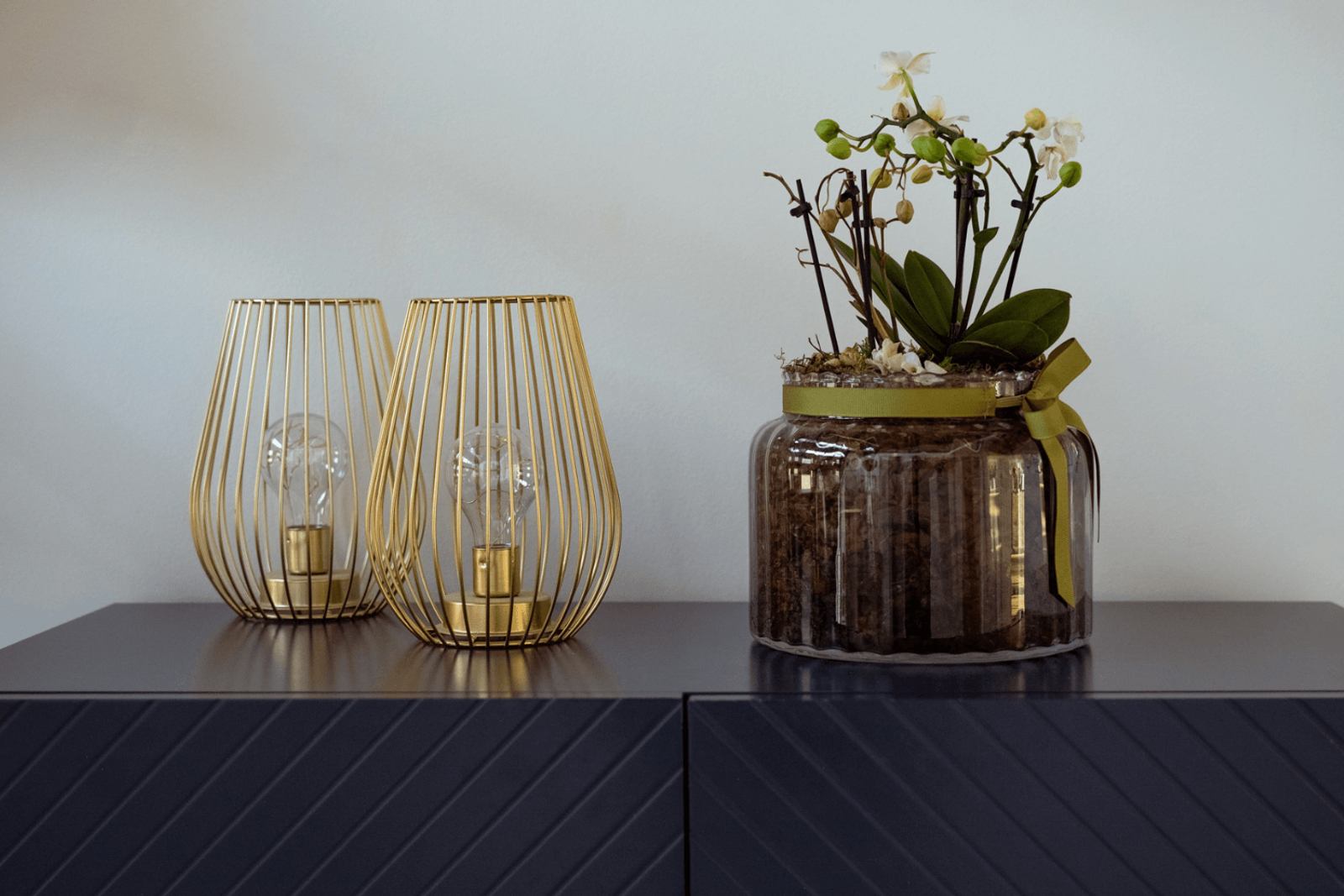
Detail becomes composition – light, material and planting brought into quiet alignment.
Beside them, a glass vessel containing an orchid sits within preserved moss. This pairing reflects a growing interest in biophilic elements within Sevenoaks interior design, where natural materials are introduced in controlled, lasting forms.
The moss is not living, but preserved – valued for its texture rather than growth.
Reflection and Layering
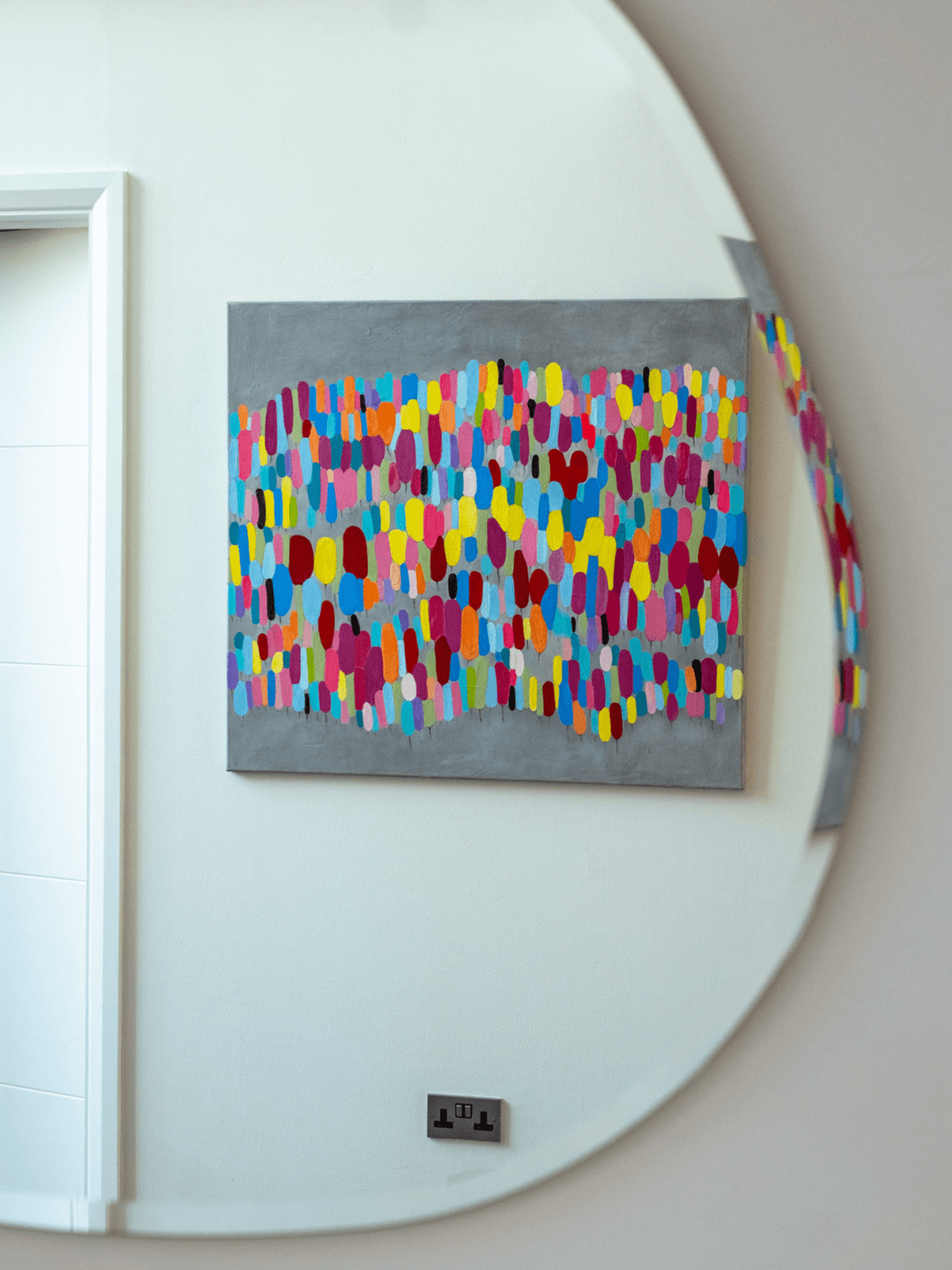
Reflection extends the space – colour and form echoed across surface and wall.
Mirrors are used sparingly, but with intention.
A curved mirror positioned near a brightly coloured painting creates a secondary composition – one that shifts with movement. The reflection softens the painting’s edges, allowing it to exist both as object and as echo.
This layering introduces depth without adding mass – a technique long used in both domestic interiors and gallery settings.
Time and Use
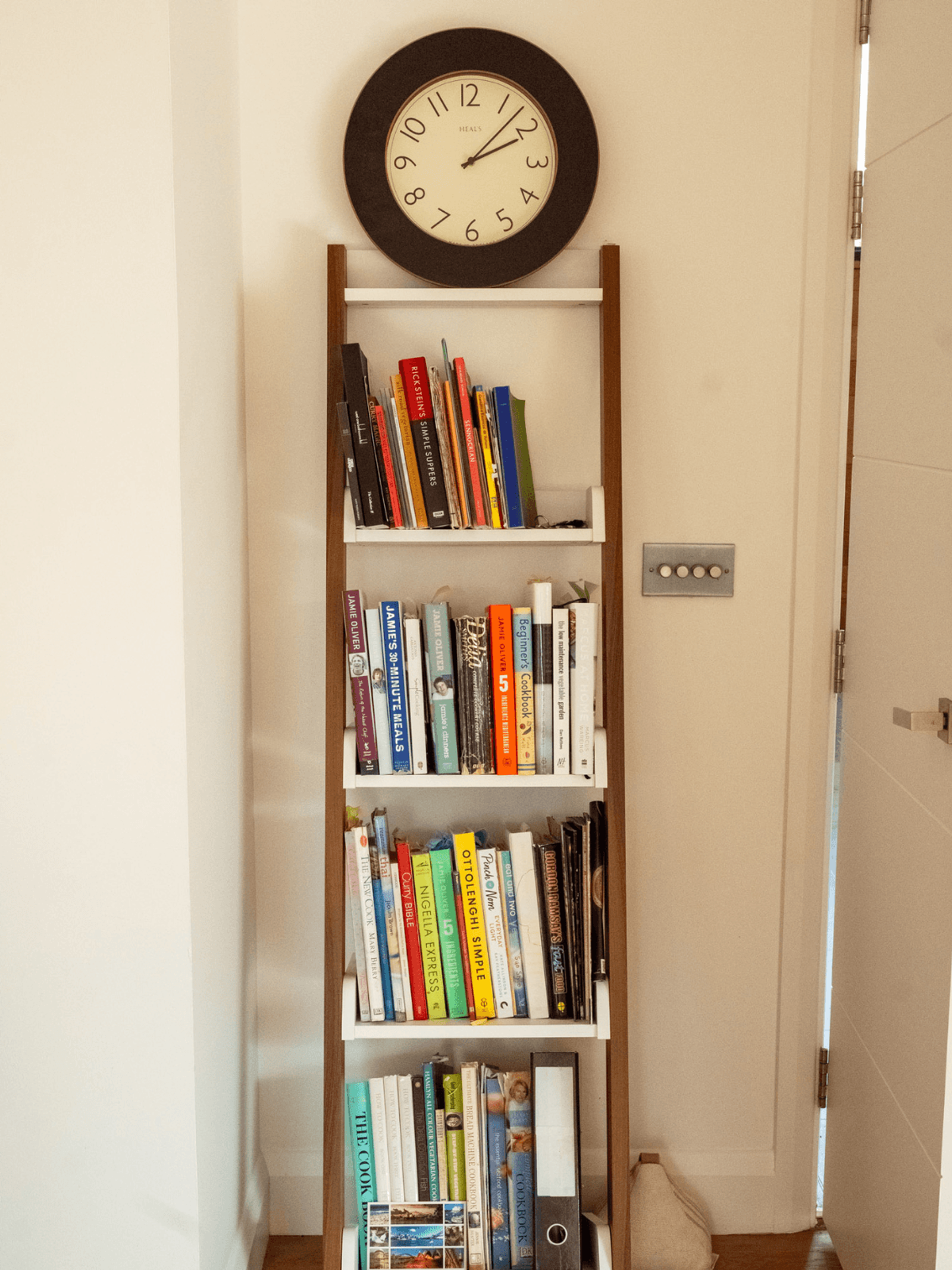
Everyday objects settle into place – books, time and routine quietly shaping the space.
In a quieter corner, a wall clock – consistent with the design language of Heal’s – sits above a shelving unit.
Heal’s, long associated with British modern design, is known for objects defined by clarity, proportion and restraint. Their clocks reflect this approach – reducing timekeeping to its most legible form.
Below, shelves of cookbooks form a dense, practical arrangement. Names such as Ottolenghi, Jamie Oliver and Nigella Lawson trace a contemporary approach to food – one that blends accessibility with global influence.
This is not display. It is use.
Living With Objects
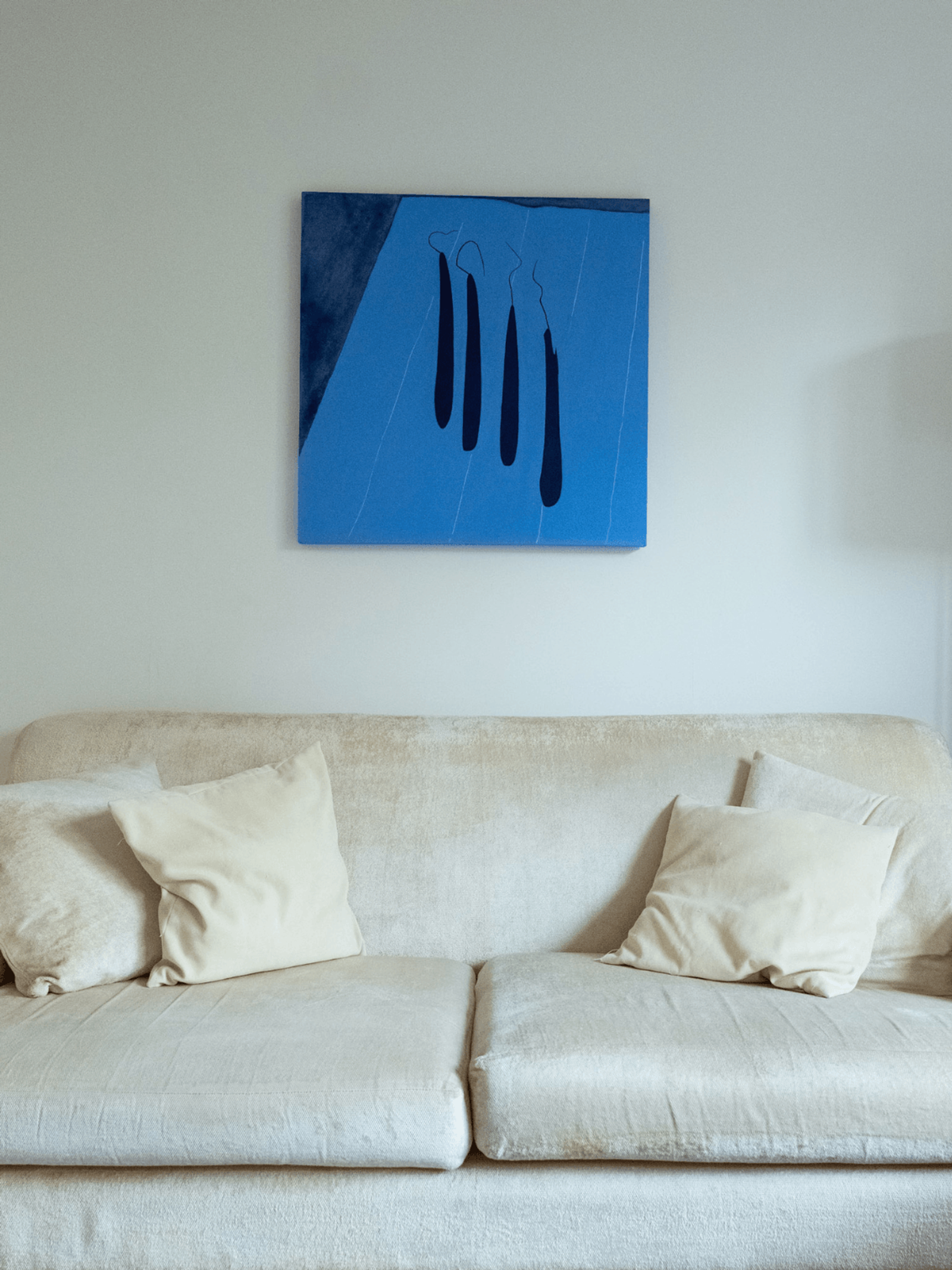
A blue abstract painting within a Sevenoaks interior design scheme, positioned above a neutral sofa to create contrast and balance.
In quieter moments, the home shifts again.
A sofa, pale and soft, sits beneath a blue painting whose composition is minimal, almost meditative. The contrast between restraint and expression reinforces the absence of a single visual language.
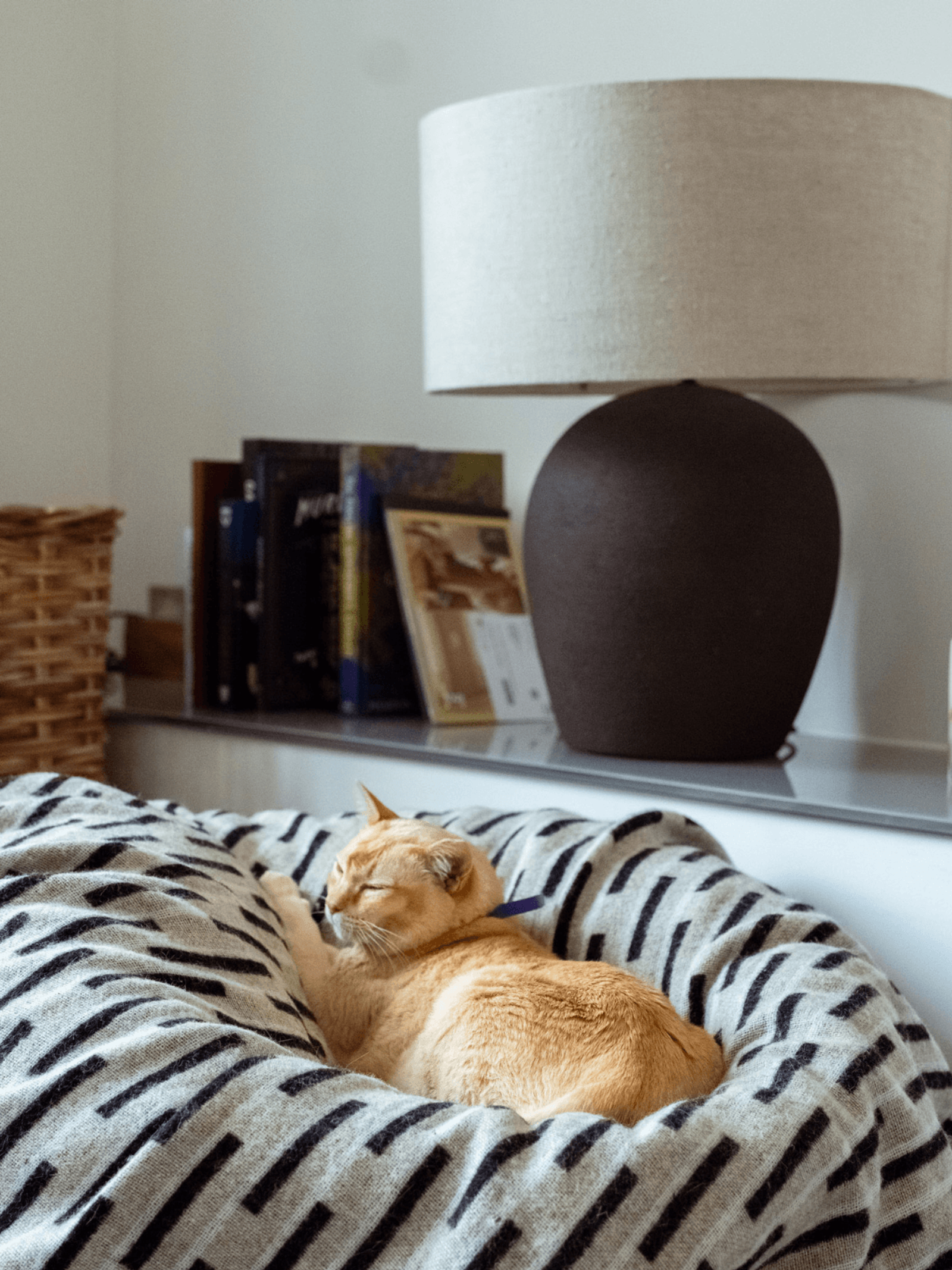
A moment of stillness – where the space becomes lived in rather than composed.
Nearby, a cat sleeps, curled into a patterned cushion.
It is a small detail, but an important one.
Because ultimately, this is what separates the home from a composed interior.
It is not fixed.
A Space That Continues
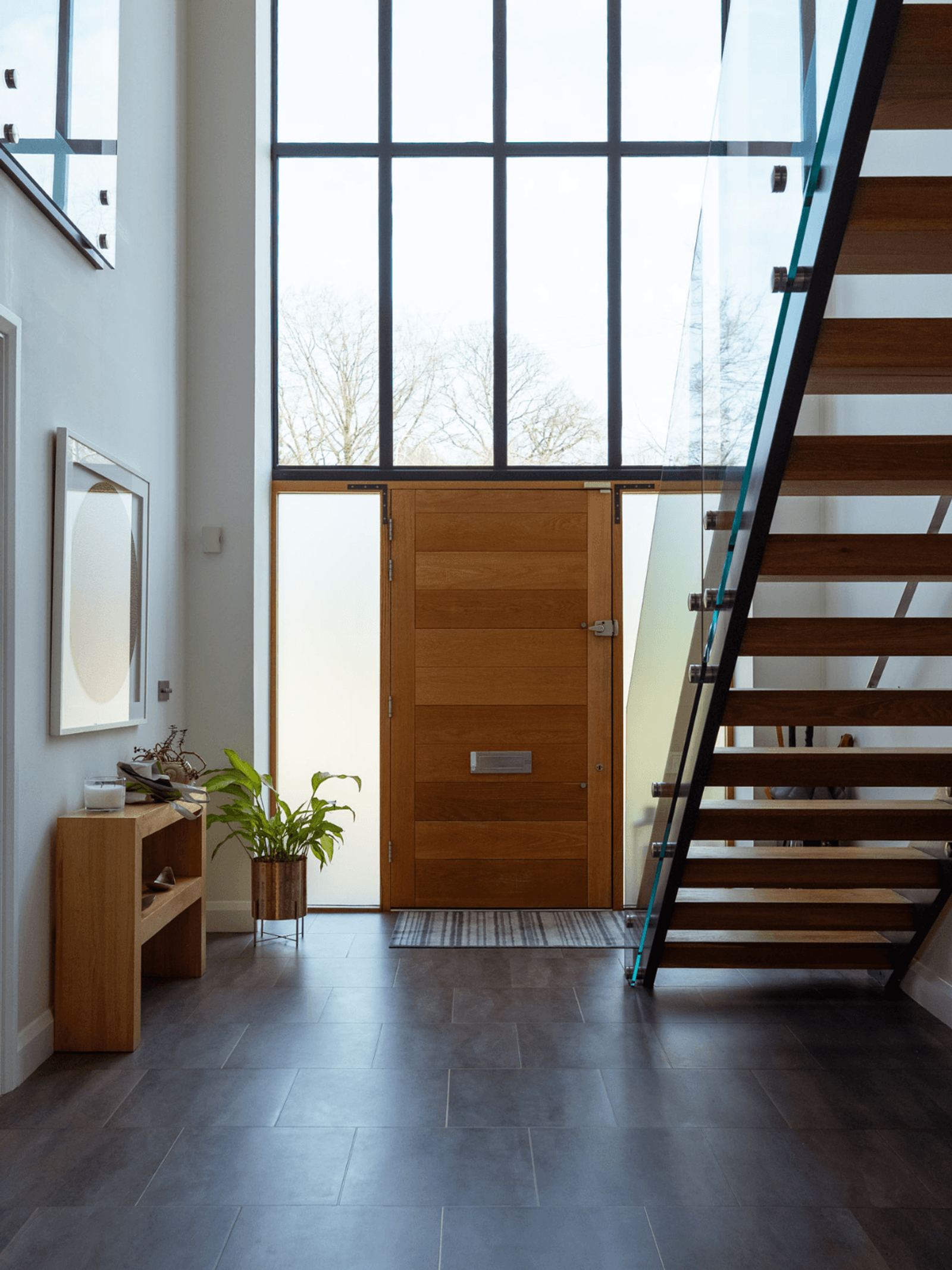
Volume and light define the entrance – a threshold shaped as much by proportion as by material.
Nothing here feels final.
Objects sit alongside one another not because they match, but because they have been allowed to remain. Some introduce contrast, others continuity. Over time, their relationships shift – not through redesign, but through use.
This is what defines the home.
Not a single moment of completion, but a quiet, ongoing evolution – where architecture provides the structure, and objects give it meaning.